
By Miles
Bear Divide Birding – D9:
This is probably our last day at Bear Divide this season. The migrant numbers are greatly declining, and nearly no one was there. Even the banding station stopped banding last week. We were also not coming for the migration today, we were here for the Black-chinned Sparrows!
As a reminder, Bear Divide is a flat area in a valley within the Angeles National Forest, where a huge number of birds migrate through. For more information about Bear Divide, please see the previous blog post: “Bear Divide Birding – D1“, or visit the Bear Divide website: https://www.beardivide.org/. For more information on the Banding Station, please see the previous blog post: “Bear Divide Birding – D3“.
We walked uphill on the road, trying to get a sound of the Black-chinned Sparrows, but we didn’t get anything close. We met some birders, but they only briefly detected the Black-chinned Sparrow using Merlin.
We decided to leave and try again at Little Tujunga Canyon Rd. at 4N35, where it was found a while ago, but not recently.
Little Tujunga Canyon Rd. at 4N35:
As soon as we got out of the car at Little Tujunga Canyon Road, we heard clearly the amazing song of Black-chinned Sparrows! We went across the road and started to wait for it to pop out. Several minutes later, the Sparrow jumped out of the bushes to a tall dried Chaparral Yucca! It sang its beautiful song and flew between Yuccas. It was so amazing!
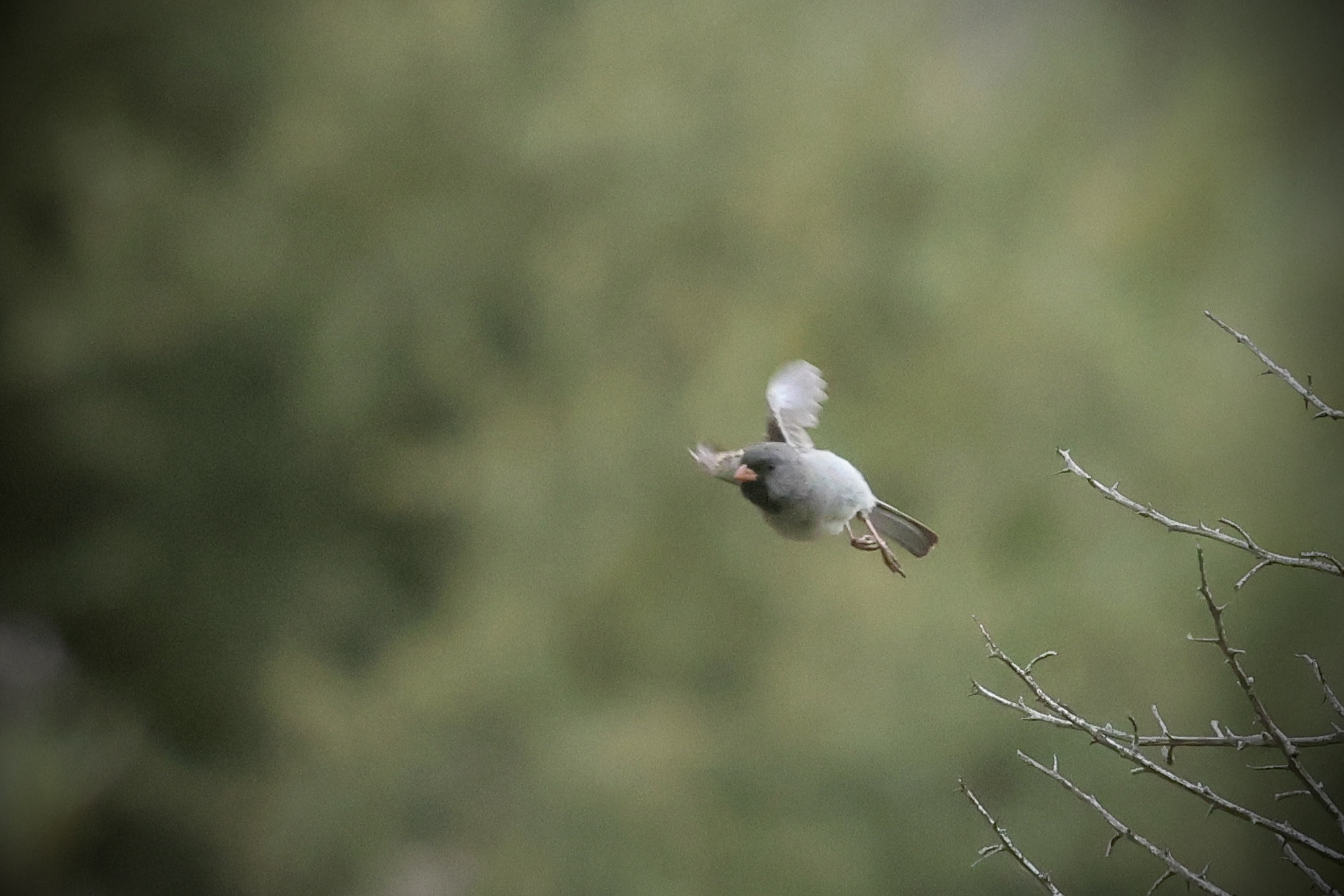
The Black-chinned Sparrow is a medium-small-sized passerine, a little bit smaller than a Yellow-rumped Warbler, with a typical sparrow/bunting/grosbeak/junco shape with a thinner beak, longer tail, and a flatter head. It has a small patch of black in front of its eye, and black all around the base of its red beak. Its throat is black, and except that the whole head is in a blueish-grey color. Its back, wings, and tail are all brown with dark stripes, and its legs are dark. Its belly and breast are light blueish-gray, and except for these, it is all blueish-gray. They are usually very territorial and live in a family or individually. They live in the arid shrubland of the mountains of southwest North America, feeding on insects and seeds.

(Black-chinned Sparrow flying, May 24th, 2025, Photo by Miles)

(Black-chinned Sparrow taking off, May 24th, 2025, Photo by Miles)

(Black-chinned Sparrow, May 24th, 2025, Photo by Miles)

(Black-chinned Sparrow, May 24th, 2025, Photo by Miles)

(Black-chinned Sparrow singing, May 24th, 2025, Photo by Miles)

(Black-chinned Sparrow singing, May 24th, 2025, Photo by Miles)

(Black-chinned Sparrow singing, May 24th, 2025, Photo by Miles)

(Black-chinned Sparrow singing, May 24th, 2025, Photo by Miles)

(Black-chinned Sparrow, May 24th, 2025, Photo by Miles)

(Black-chinned Sparrow singing, May 24th, 2025, Photo by Miles)
The eBird checklist for Bear Divide D9: https://ebird.org/checklist/S235803070