
By Miles
It’s our third Bear Divide day of the year, and we’re already seeing a sharp rise in both species variety and total bird counts.
Bear Divide is a flat area in a valley within the Angeles National Forest, with a huge number of birds migrating through. For more information about Bear Divide please see the previous blog post: “Bear Divide Birding – D1“, or visit the Bear Divide website: https://www.beardivide.org/.
On the second day, Chipping Sparrows, Lawrence’s Goldfinches, and Yellow-rumped Warblers were already rising. There are hundreds of Yellow-rumped Warblers, and more than 50 Lawrence’s Goldfinchs and Chipping Sparrows. Today, the Lazuli Bunting’s amount made a sharp rise, even the people working at the banding station said it was a busy day for Lazuli Buntings. Even we saw at least 15 of them. The Black-headed Grosbeak also started to pass through, and became the first banded bird I observed today.
The Banding Station was set up at Bear Divide in 2021. Before that, the first to notice those huge amounts of birds migrating through was some people having meetings there. As the news spread, bird counters started to count the migrating birds every spring. With their success, the banding project started the following year. There are in total of 7 mist nets at Bear Divide to catch birds without harming them. Every several minutes, the banders set out to the nets to collect each bird in a comfortable bag. Then they carry them downhill back to the banding station where they collect information about the bird’s DNA, sex, age, and lots of other details. Finally, they give the bird a special numbered metal band, let the people nearby get a close look at this amazing little bird, and set it free, either to continue migrating in the sky or let them calm down in the bushes.
In two weeks the great migration of Bear Divide will reach its peak, let’s wait and see!
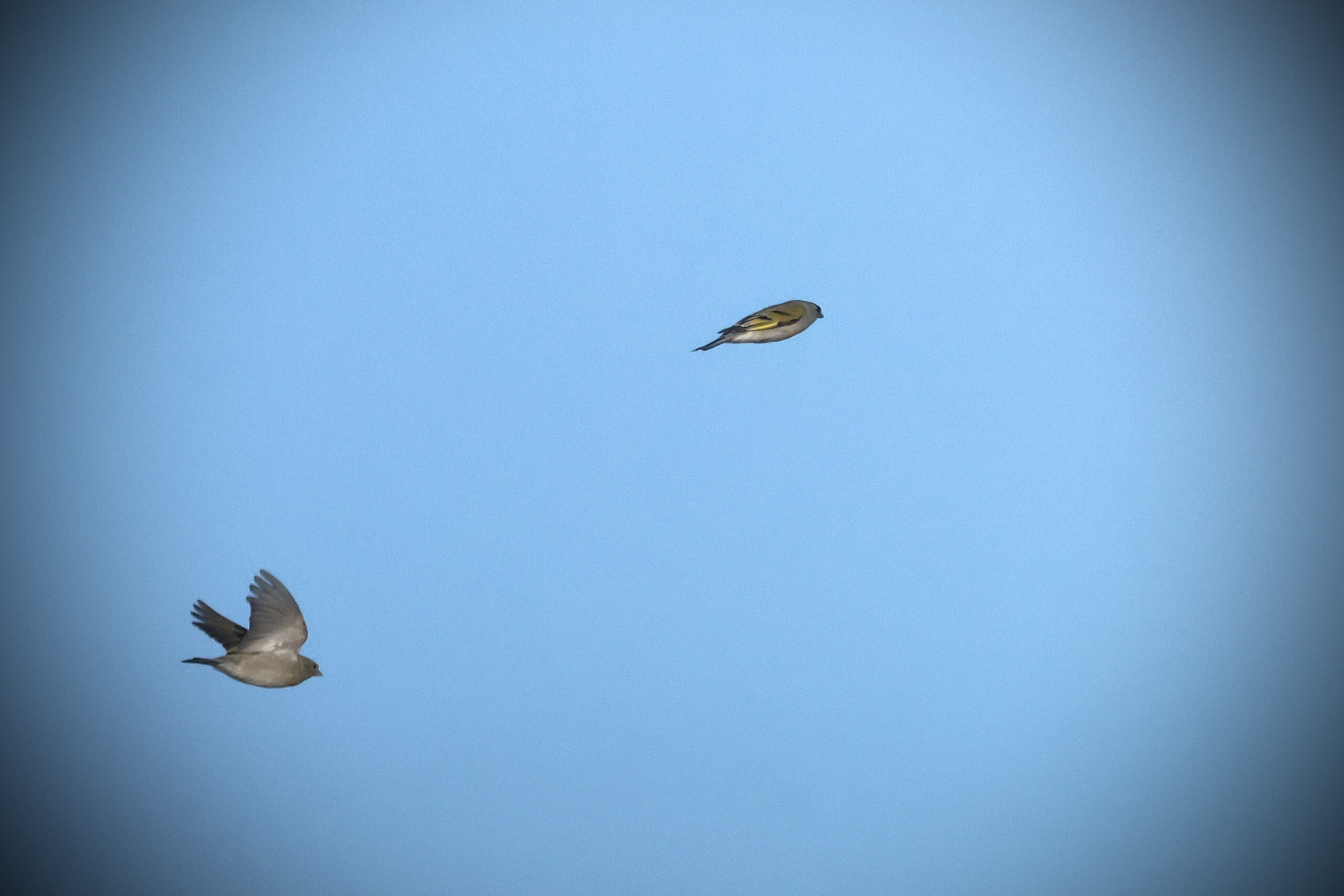
The Lawrence’s Goldfinch is a small-sized passerine, smaller than a Yellow-rumped Warbler, with a typical Goldfinch shape, and a cone-shaped beak. Its male has a black forehead, lore, and throat, while its scapulars, greater covers, eagle of flight feathers, and breast are bright golden yellow. The rest of the wings and tail are black with a white border and its feet are black. Except for these, its whole body is all light gray. Its females have all these the same, except that they have neither black forehead, lore, and throat or yellow breast. They usually live in small flocks, in open areas and dry savannas in most of California and parts of Arizona, New Mexico, and Baja California feeding on seeds of the grasses.

(Lawrence’s Goldfinch flying pass, April 7th, 2025, Photo by Miles)

(Lawrence’s Goldfinch migrating in groups, April 7th, 2025, Photo by Miles)
The Lazuli Bunting is a small passerine, smaller than a Yellow-rumped Warbler, with a typical Bunting shape, and a cone-shaped beak. Its male has a blue head, back, wings, and tail with a white wing bar, while its breast is orangish-yellow and its lore is black. The rest of its body is white with black feet. Its females are all brown with darker wings and tails. They usually live lonely, in open areas full of bushes and high grasses, and in some city environments in most of the western United States feeding on seeds of the grasses and some insects.

(banded Lazuli Bunting, April 12th, 2025, Photo by Miles)

(Lazuli Bunting, April 12th, 2025, Photo by Miles)

(Lazuli Bunting, April 12th, 2025, Photo by Miles)

(Lazuli Bunting, April 12th, 2025, Photo by Miles)

(Lazuli Bunting in migration groups, April 12th, 2025, Photo by Miles)

(Lazuli Bunting in migration groups, April 12th, 2025, Photo by Miles)

(Lazuli Bunting migrating, April 12th, 2025, Photo by Miles)
Other pictures of D2 & D3:

(Western Tanager migrating pass, April 7th, 2025, Photo by Miles)

(Western Tanager flying pass, April 7th, 2025, Photo by Miles)

(Western Tanager migrating alone, April 7th, 2025, Photo by Miles)

(Chipping Sparrow, April 7th, 2025, Photo by Miles)

(Lark Sparrow, April 7th, 2025, Photo by Miles)

(Lark Sparrow, April 12th, 2025, Photo by Miles)

(Rufous Hummingbird?, April 12th, 2025, Photo by Miles)

(banded Black-headed Grosbeak, April 12th, 2025, Photo by Miles)

(Black-headed Grosbeak, April 12th, 2025, Photo by Miles)

(Black-headed Grosbeak, April 12th, 2025, Photo by Miles)

(Western Kingbird resting during migration, April 12th, 2025, Photo by Miles)

(Bear Divide banding station, April 7th, 2025, Photo by Hugo)
the eBird checklist for D2: https://ebird.org/checklist/S223777614
the eBird checklist for D3: https://ebird.org/checklist/S225073417