
By Miles
* THIS IS A LATE POST FOR APRIL 19th AND 20th (D4 AND 5),IT IS ALREADY D6 AND 7 NOW
It’s our fourth and fifth day at Bear Divide this year, the species variety and total bird counts are both getting higher, but the greatest forces of Warblers are still not coming.
Bear Divide is a flat area in a valley within the Angeles National Forest, where a huge number of birds migrate through. For more information about Bear Divide, please see the previous blog post: “Bear Divide Birding – D1“, or visit the Bear Divide website: https://www.beardivide.org/.
On the fourth day, there were really a lot of Lazuli Buntings, and the banding station was catching a bunch of Hummingbirds, and was allowing us to actually see the special tail feathers of the Rufous Hummingbird. Also, they even got a Costa’s Hummingbird, which was brilliant under the sunlight. We also got the first two Hermit Warblers, but they flew past very fast and I couldn’t get a photo of them.

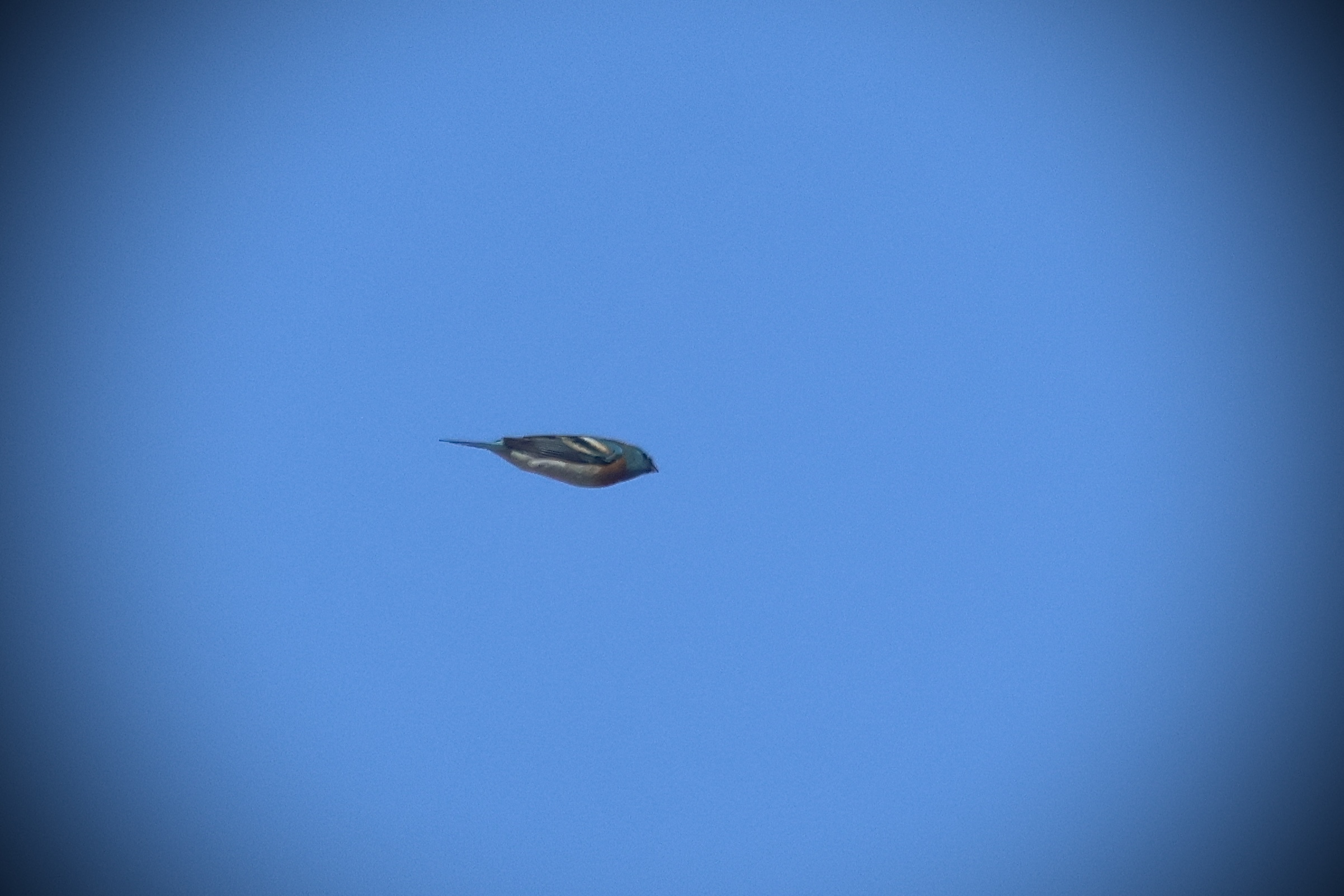
(Lazuli Bunting flying past, April 19th, 2025, Photo by Miles)

(Lawrence’s Goldfinch flying past, April 19th, 2025, Photo by Miles)

(Banded Blue-gray Gnatcatcher, April 19th, 2025, Photo by Miles)

(Banded Blue-gray Gnatcatcher, April 19th, 2025, Photo by Miles)

(Banded California Thrasher, April 19th, 2025, Photo by Miles)

(Banded California Thrasher, April 19th, 2025, Photo by Miles)

(Banded California Thrasher, April 19th, 2025, Photo by Miles)

(Banded California Thrasher, April 19th, 2025, Photo by Miles)

(Banded Costa’s Hummingbird, April 19th, 2025, Photo by Miles)
Rufous Hummingbird is a super tiny climbing bird that doesn’t climb, smaller than half the size of a Yellow-rumped Warbler, with a typical Hummingbird shape, and looks exactly like an Allen’s Hummingbird. It looks so like the Allen’s Hummingbird that unless it was an adult male, no one can separate them in the field. The only thing that really separates them is the tail feathers. The tail feather #2 (from the middle) of a Rufous Hummingbird has a notch at the tip, and the outer tail feathers are slightly broader, which gives them different display calls. The Rufous Hummingbird males have a green top, a structurally colored throat that becomes orange in certain conditions. The rest of its head, belly, and back are rufous colored. The tips of its tail feathers and flight feathers are black, and the upper cover of the wings is green. Its breast and lower tail covers are white, and its eyes, beak, and legs are black. The females and immatures have a green top, back, upper tail covers, and upper wing covers, green striped throat, and the rest of their head, breast, and lower tail covers are white. The tips of its tail feathers have a black and white pattern, and its flight feathers are black. Its eyes, beak, and legs are black, and the rest of its body is rufous. They are usually found in every habitat of North America, feeding on nectar and small bugs. They are also very migratory and have the longest migration routes among all of the North American Hummingbirds.

(Banded Rufous Hummingbird, April 19th, 2025, Photo by Miles)

(Banded Rufous Hummingbird, you can see the tail feather #2 (from the middle) of the Rufous Hummingbird has a notch at the tip, April 19th, 2025, Photo by Miles)

(Banded Rufous Hummingbird, April 19th, 2025, Photo by Miles)

(Banded Rufous Hummingbird, April 19th, 2025, Photo by Miles)

(Banded Rufous Hummingbird, April 19th, 2025, Photo by Miles)
On the fifth day, it was at first just as normal and slow as the fourth day. But one time today, when we got back from the banding station, we saw some people looking down the canyon, pointing at something. IT WAS TWO MOUNTAIN QUAIL!!! We finally actually “saw” a Mountain Quail! It was so cool with the “exclamation point” on its head!
The banding station was quite busy today, lots of birds were caught, and even a Nashville Warbler! It was the first time for me to see a Nashville Warbler, and it was also the first time I saw a warbler banded! The adult male warbler has a brilliant yellow breast, and the small red crown was very clear since we were so close!
For more information on the Banding Station, please see the previous blog post: “Bear Divide Birding – D3“.

(Banded Ash-throated Flycatcher, April 20th, 2025, Photo by Miles)

(Banded Hermit Thrush, April 20th, 2025, Photo by Miles)

(Banded Hermit Thrush, April 20th, 2025, Photo by Miles)

(Banded Hermit Thrush, April 20th, 2025, Photo by Miles)
Mountain Quail is a medium-small-sized Terrestores, about the same size as two Yellow-rumped Warblers, with a typical New World Quail shape. The most interesting part of the Quail is that it has two prominent, straight, black plumes that stick straight up from the front of its head, like an exclamation point. The whole body of the Quail is blueish-gray, with a reddish-brown throat and a black eye pattern. The white outline of the throat is connected to the eye pattern, like a collar, but gets thinner in the middle (completely no white right underneath the beak). They have a dark reddish-brown belly and short white vertical stripes on their flanks. The back and wings are less blueish and more brown and have two white outlines. It likes to move on the ground in small groups and live in dense bushes. It is timid and good at hiding. Although it is small in size, its call is extremely loud, and can be heard from a long distance, which makes it seem very mysterious. It is a simple, short, and sharp call of “kwaa! (wait for a little bit of time) kwaa!…”, piercing the air with its crisp call.

(Mountain Quail, April 20th, 2025, Photo by Miles)

(Mountain Quail, April 20th, 2025, Photo by Miles)

(Mountain Quail, you can see the funny feathers on its head, April 20th, 2025, Photo by Miles)

(Mountain Quail, April 20th, 2025, Photo by Miles)

(Mountain Quail, April 20th, 2025, Photo by Miles)

(Mountain Quail, April 20th, 2025, Photo by Miles)

(Mountain Quail habitat, April 20th, 2025, Photo by Miles)

(Mountain Quail, April 20th, 2025, Photo by Miles)
Nashville Warbler is a medium-small-sized passerine, a little bit smaller than a Yellow-rumped Warbler, with a typical warbler shape. It has a white eyering, a small red striped crown, and a yellow throat. And except that the whole head is in a pale grey color. Its back, wings, and tail are yellowish-green. Its legs are dark colored, and it has bright yellow in all of the other parts of its body. They are usually alone in forests in North America, feeding on insects and other bugs.

(Banded Nashville Warbler, April 20th, 2025, Photo by Miles)

(Banded Nashville Warbler, April 20th, 2025, Photo by Miles)

(Banded Nashville Warbler, April 20th, 2025, Photo by Miles)

(Banded Nashville Warbler, April 20th, 2025, Photo by Miles)
The weather on D6 and D7 was very bad, very windy and cold, and there weren’t many birds migrating through.
In two weeks, the great migration at Bear Divide will reach its peak. Let’s wait and see!
The eBird checklist for D4: https://ebird.org/checklist/S227162918
The eBird checklist for D5: https://ebird.org/checklist/S227630783
The eBird checklist for D6: https://ebird.org/checklist/S229753933
The eBird checklist for D7: https://ebird.org/checklist/S230129148