
By Miles
This spring break, my family and I went on a fantastic birding and sightseeing trip to California’s Central Valley and the south-central coastal area.

* The articles about this trip will be divided into three separate blog posts:
- D1 – the Forest of Giants, D2 – Condor of the Pinnacles
- D3 – Exploring Monterey
- D4 – Big Sur Forest, D5 – Seaside SLO, D6 – Vanguard of the Sea
D1 – The Forest of Giants:
On the first day of the trip, we went to the Sequoia and Kings Canyon National Parks. The huge trees there were amazing, but there were almost no birds.
The biggest tree in the world, the General Sherman Tree is Huge – but not as large as I thought. But the national Christmas tree, General Grant Tree, and its surrounding sequoia forests were amazing. They actually looked even bigger and made me feel more like walking in “forests of giants”, like what the NPS website said.
It was quite cold, and the mountain was covered in deep snow everywhere like it was still winter. The weather forecast said another major snowstorm was on the way, but we were lucky and got there before it. The main roads were already cleaned, so we weren’t required to have snow chains. Some roads in the mountains were still closed because of earlier snowfalls, but it didn’t affect our trip.
The Big Stumps we visited at last were huge and looked like stages instead of tree stumps, and they were not even the biggest tree! As the sun went down, we started to head towards the heart of the Central Valley, enjoying the stunning scenery along the road down the mountains.

(Sequoia NP, March 30th, 2025, Photo by Miles)

(beautiful snowy mountains of Sequoia NP, March 30th, 2025, Photo by Miles)

(the giant General Sherman Tree, March 30th, 2025, Photo by Miles)

(Sequoia forests, March 30th, 2025, Photo by Miles)

(National Christmas tree, General Grant Tree, March 30th, 2025, Photo by Miles)

(Sequoia forests, March 30th, 2025, Photo by Miles)

(a huge Sequoia stump, March 30th, 2025, Photo by Miles)

(beautiful scenery of Kings Canyon NP, March 30th, 2025, Photo by Miles)
D2 – Condor of the Pinnacles:
On the second day of the trip, we got to the Pinnacles National Park, famous for its large populations of the endangered California Condors.
The first Condor of the day was seen at the visitor center as we were going to ask the ranger for some information, but it was pretty far away.
We then got to the Condor Gulch trail and started to hike up to get a better view of the Condors. We met a birder on the road who had seen a lot of Condors, he said the best place was the highest point, which was 20 minutes uphill. So, we soon got there and thought it was the best point and did see lots of condors.
After it was time to go back, we decided to go another way. Very soon, we found that we were getting closer to the peaks and some people were climbing it. We thought they were just doing it for fun, but soon we found that it was not optional at all, we must do it too! It is what has been called “the Steep and Narrow Section”!
After climbing the super steep and narrow section we reached a high flat point, and a Condor was sitting just a few feet in front of us! And a perfectly full-grown adult was sitting in a cave right underneath us, and other Condors kept hovering over us and the flock changed Condor frequently, unbelievable! It was such a fantastic place to go and definitely worth the climb of the super steep and narrow section!
After watching them for a long time, the Condors over our heads dropped down and so many other Condors started to join them – like all the Condors of the world were coming to meet us. And then they started to perch all around us and we were suddenly surrounded by Condors, not knowing where to look and where to photograph! They fought to get to rocks and trees that were higher, and they were gliding so close to us that we could even feel the enormous bodies of them going around. It’s just unbelievable and sooooooooo amazing! Finally, Condors had covered every single rock around us and even several trees. This was really one of the best birding experiences I’ve ever had! As we climbed downhill, we found that they were all roosting on some trees under where we had just been, hiding from the rain!
It was such an amazing day!

(Pinnacles NP, March 31st, 2025, Photo by Miles)

(Pinnacles NP’s beautiful scenery, March 31st, 2025, Photo by Miles)
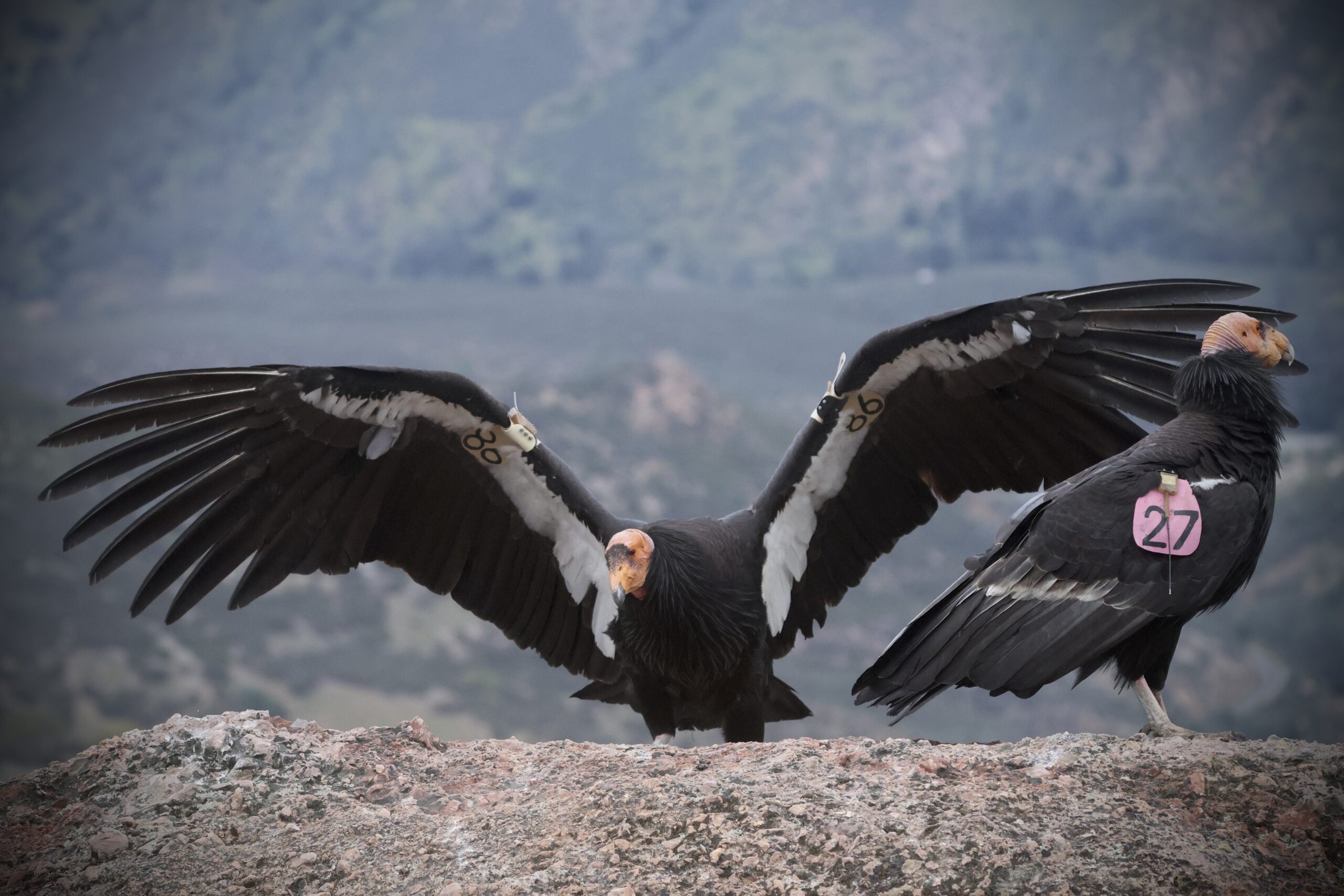
The California Condor is a huge raptor, about eight and a half times the size of a Yellow-rumped Warbler, with a huge wingspan of 277cm (9ft), and a completely bald and fat head. An adult Condor has a pinkish-orange head with some short black feathers in front of and between the eyes and a blueish-gray throat with a red dot, while an immature Condor has all this in black. All Condors have an area of red skin on the breast that is usually covered with feathers and is uncovered when it is too hot, to cool down. Its wing linings, secondary covers, and feet are white (although the wing linings of an immature Condor were more of a greyish-white color). And the rest of the Condor are all black. They usually forage on dead animals and live in flocks.
They used to live in all the open areas, savannas, and cliffs across the mountains of western North America. But condor populations suffered a huge decline in the 20th century due to lots of agricultural chemicals and lead poisoning in dead animals they feed on, illegal hunting, garbage being eaten because it looks like bones, and a huge amount of habitat loss. The US government captured the last 27 wild condors by 1987. They were brought to the San Diego and Los Angeles Zoo. The captive populations grew through breeding, and starting in 1991, condors were reintroduced into the Pinnacles, Grand Canyon, and Zion NP. The Condors are fitted with special numbered tags and trackers, and their chicks are also tracked and will receive the same equipment as soon as they are strong enough to handle it. So, keep an eye out for this special equipment when you look at the photos! After that, their population again spread to most of the area nearby, and nests were again built by them in the wild, and more and more new Condors were hatched.

(California Condor: white#86 and pink#27, March 31st, 2025, Photo by Miles)

(California Condor: white#86, March 31st, 2025, Photo by Miles)

(California Condor: white#86 and pink#27, March 31st, 2025, Photo by Miles)

(California Condor: white#86 and pink#27, March 31st, 2025, Photo by Miles)

(California Condor: white#86 and pink#27, March 31st, 2025, Photo by Miles)

(California Condor: white#86 and pink#27, March 31st, 2025, Photo by Miles)

(California Condor: pink#27, March 31st, 2025, Photo by Miles)

(California Condor: pink#27, March 31st, 2025, Photo by Miles)

(California Condor: blue#40 and green#26, March 31st, 2025, Photo by Miles)

(California Condor: blue#40 and green#26, March 31st, 2025, Photo by Miles)

(California Condor: pink#27 and green#26, March 31st, 2025, Photo by Miles)

(California Condor: pink#27 and green#26, March 31st, 2025, Photo by Miles)

(California Condor: pink#27, green#26, and two others, March 31st, 2025, Photo by Miles)

(California Condor: pink#27, green#26, and an other Condor, March 31st, 2025, Photo by Miles)

(California Condor: pink#27 and white#86, March 31st, 2025, Photo by Miles)

(California Condor: orange#34, March 31st, 2025, Photo by Miles)

(California Condor: black#69, March 31st, 2025, Photo by Miles)

(California Condor: black#69, March 31st, 2025, Photo by Miles)

(California Condor: black#69, March 31st, 2025, Photo by Miles)

(California Condor: black#69, March 31st, 2025, Photo by Miles)

(California Condor: black#69, March 31st, 2025, Photo by Miles)

(California Condor: green#47, March 31st, 2025, Photo by Miles)

(California Condor: green#47, March 31st, 2025, Photo by Miles)

(California Condor: green#47, March 31st, 2025, Photo by Miles)

(California Condor: orange#?, March 31st, 2025, Photo by Miles)

(California Condor: pink#?, March 31st, 2025, Photo by Miles)

(California Condor: pink#27, March 31st, 2025, Photo by Miles)

(California Condor: orange#85, March 31st, 2025, Photo by Miles)

(California Condor: orange#19, March 31st, 2025, Photo by Miles)

(California Condor: green#26, March 31st, 2025, Photo by Miles)

(California Condor: orange#19, March 31st, 2025, Photo by Miles)

(California Condor: pink#27 and non-banded immature Condor, March 31st, 2025, Photo by Miles)

(California Condor: orange#85 and orange#19, March 31st, 2025, Photo by Miles)

(California Condor: orange#19, March 31st, 2025, Photo by Miles)

(California Condor: yellow#117, March 31st, 2025, Photo by Miles)

(California Condor: yellow#117, March 31st, 2025, Photo by Miles)

(California Condor: red#92, March 31st, 2025, Photo by Miles)

(California Condor: green#26, March 31st, 2025, Photo by Miles)