By Miles
There are only three species in the Genus Phalaropus in the whole world. They are all cute little “sandpipers” with distinct behavior and breeding habits. One of the most interesting facts of the Phalaropus or Phalaropes is that they are polyandrous and have reversed sexual dimorphism, where females have a lot more fancy plumage and do courtship displays to let males choose them as mates! It’s the exact opposite of what most birds do! And even further the female birds don’t take care of the off springs at all. They just fly south as soon as mating ends, and let the males take care of the babies and migrate later in the real fall. In fact, two Wilson’s Phalarope literally arrived at LA river for fall migration and it was still June, the first half of the year! I will be talking about these Phalaropus in this blog. Let’s get through them one by one!
Wilson’s Phalarope:
This is the last Phalarope that I need, to see all three species. June 26th, two female Wilson’s Phalaropes were reported on eBird at LA River — Willow St.. So on Saturday, we went straight there after getting the Yellow-headed Blackbird of Ken Malloy Harbor Regional Park (where the STKI is). As soon as we got there, we met Jeff, who pointed the Phalaropes out for us. They were feeding by swimming and occasionally walking in the middle section of the River where there’s a little more water. Although they swim a lot more than other sandpipers they are still the more un-aquatic of the three, with less lobed toes.
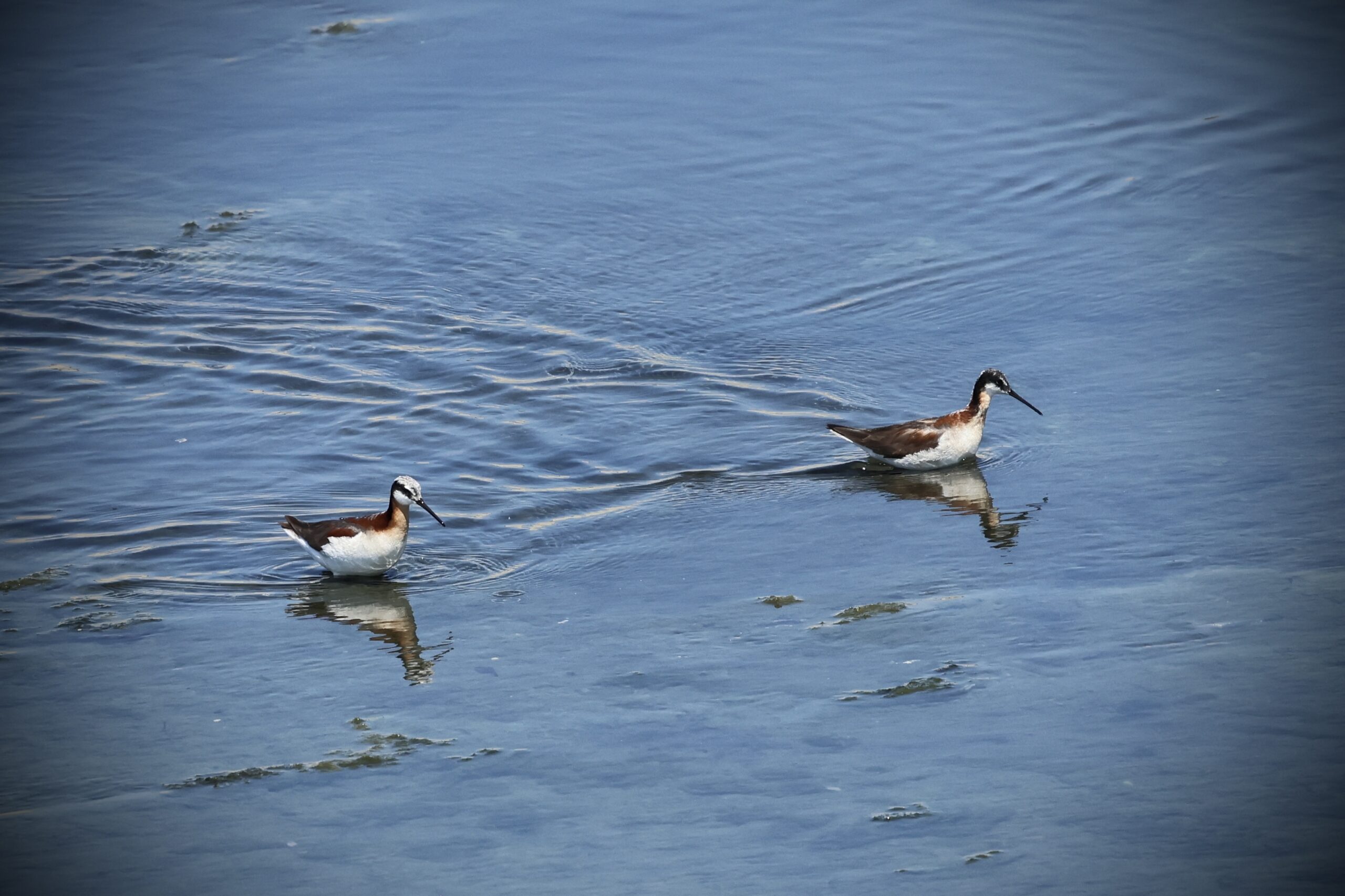
The Wilson’s Phalarope (Phalaropus tricolor) is a small-sized shorebird, even smaller than the size of two Yellow-rumped Warblers, with a typical Phalarope shape (straight, thin billed small buck-like swimming sandpiper with) and a thinner and longer bill than the other two.
Its female is very colorful and gives it the scientific name tricolor. Its eye lines are black and connect to the black line along the sides of the neck and smoothly transite into the dark reddish brown (almost chestnut colored) part of the back all black. Continuing on the head, it has a blue-grayish white crown, a short white supercilium, and a bright white ear-patch and throat. Going down, the front side of its neck is light orange and the non-black part of the side is dark reddish brown (just like the back is connected to it), and the very middle part of the back side is white. Its breast, belly, both tail-cover is white and the wings and tail are brown. At last, the most colorful back. The Mantle is blueish-gray, a dark reddish brown line goes on the side of it. The Scapulars are mostly also blueish-gray, and the extended feathers of the Scapulars are dark reddish brown. The male is less colorful, but follows the same general patterns. It has less blacks, a darker cap, an all brown back, and more mixed-up colors, but still the distinctive white ear-patch and throat.
In the winter they change into non-breeding plumage that is un-colorful at all, it still follows the same exact general patterns but every thing is gray. The white ear-patch and throat will no longer work and the best way to distinguish it from the other two would be the bill shape and a pale gray line at the location where the black one should be. They like to move in groups in inland watered areas, and feed on small aquatic invertebrates in freshwater by a special technique that is also done in Red-necked Phalaropes. They chase the prey in circles in a small area of water (more in the Red-necked section) and use surface tension of water between mandibles to transport prey from the tip of the beaks into the mouth!
(Wilson’s Phalarope (Phalaropus tricolor) females, June 28th, 2025, Photo by Miles)
(Wilson’s Phalarope (Phalaropus tricolor) female, June 28th, 2025, Photo by Miles)
(Wilson’s Phalarope (Phalaropus tricolor) female, June 28th, 2025, Photo by Miles)
(Wilson’s Phalarope (Phalaropus tricolor) female, June 28th, 2025, Photo by Miles)
(Wilson’s Phalarope (Phalaropus tricolor) females, June 28th, 2025, Photo by Miles)
(Wilson’s Phalarope (Phalaropus tricolor) female, June 28th, 2025, Photo by Miles)
(Wilson’s Phalarope (Phalaropus tricolor) female, June 28th, 2025, Photo by Miles)
(Wilson’s Phalarope (Phalaropus tricolor) female, June 28th, 2025, Photo by Miles)
Red-necked Phalarope:
This is not only the second Phalarope species I saw, but also the second Phalarope I’ve ever seen. I got this lifer at LA River — Willow St. just like the Wilson’s, but on a PAS (Pasadena Audubon Society) field trip instead of on my own.
The Red-necked Phalarope (Phalaropus lobatus) is a small-sized shorebird, even smaller than the Wilson’s Phalarope, with the typical Phalarope shape and a thinner and longer bill than Red Phalaropes that I will talk about next, but still not as thin and long as Wilson’s Phalarope.
Its female is colorful too, although not as much. Its entire head is black except the white throat and notch on top of each eye. The neck is entirely red except the very middle part of the back side is white. The red has a harsh transition to the surroundings and even the paler breast too. Its breast, belly, under-tail-cover has white with black horizontal stripes and the wings and tail are brown with one white wing bar. At last, the most colorful back. The Mantle is black, a light orange line goes on the side of it, the Scapulars are mostly also black, and the extended feathers of the Scapulars are black with light orange near the normal Scapular feathers. The male is less colorful, but follows the same general patterns. It has less blacks (more brown with lots of white spots), a darker cap, a more mixed-up back, and more mixed-up colorations overall, but still the distinctive white throat only with a black ear-patch.
In the winter they change into non-breeding plumage that is un-colorful at all, it still follows the same exact general patterns but every thing is gray, just like Wilson’s, except that it’s neck becomes all white. They like to move in groups in watered areas, and become more pelagic during non-breeding seasons. They feed on small aquatic invertebrates in both salt and freshwater by a special technique that is also done in Wilson’s Phalaropes (just mentioned when talked about Wilson’s). They chase the prey in circles in a small area of water to draw food up into the feeding range. Then they use surface tension of water between mandibles to transport prey from the tip of the beaks into the mouth! Interestingly, some study showed that one individual usually only spins in one single direction. The Phalaropes might be “handed”!
(Red-necked Phalarope (Phalaropus lobatus) non-breeding, August 26th, 2025, Photo by Miles)
(Red-necked Phalarope (Phalaropus lobatus) non-breeding, August 26th, 2025, Photo by Miles)
Red Phalarope:
My first Phalarope!!! I saw this when I was still in China where all Phalaropes are very very rare at any time. One day, when I was birding in Shahe river, one of the birdest spots in Beijing, some one searching the rare owl with us got a massage of a Red-necked Phalarope being found on the other side of the river/wetland! We quickly got in the car and got to the location and there it was. A Red not Red-necked Phalarope was swimming right in front of us! It was so close we could sometimes even see its special toes when it got on the muds! Lots of birders soon gathered as the massage spread quickly. But sadly the next morning the birders going only found some gray phalarope feather, and the bird was presumed eaten by pet cat let out by human. (DO NOT LET YOUR CAT OUT!!!)
The Red Phalarope (Phalaropus fulicarius) is a small-sized shorebird, similar to the size of the Wilson’s Phalarope, with the typical Phalarope shape and a thicker and shorter bill than the previous two that I just talked about.
Its female is also colorful. Its cap, throat, and tip of the yellow bill are black. The rest of the head is white and its entire neck, breast, belly, and both tail-covers are entirely pure orange. The back of the Red Phalarope isn’t as colorful as the other two. The Mantle is black with light orange spots. A light orange line goes on the side of it. The Scapulars are mostly also black, with light orange edges on each feather. The male is less colorful, but follows the same general patterns. It has some white feathers on the red belly, a streaky brown cap and throat, and more mixed-up colorations overall, but still distinctively entirely red. In the winter they change into non-breeding plumage that is un-colorful at all, it DOES NOT follow the same patterns this time, but everything is still gray. In those days it nearly became a Red-necked Phalarope. The only differences are that Red still has a different bill, Red has a pure gray back, but Red-necked have a gray-and white mixed back, Red some times show a little bit of yellow on the base of the beaks, and Red might show some orange shade on the neck.
They like to move in groups in watered areas, and are the most pelagic species of the three, they spend all of their winter and migration seasons on the open ocean. Unlike the other Phalaropes they feed on and feed on adult and larval Insecta, plant materials, copepods, amphipods, fish eggs, larval fish, mysids, and euphausiid. They also forage differently, they often dip head below the water surface while wading or swimming unlike the other two usually just stay above. Sometimes, they could even get upends while swimming, occasionally accompanied by small jumps. Chasing prey in circles like the other two are done only in very shallow water and especially on breeding grounds. When at sea, as they do for most of the year, they do a quick, downward, nearly vertical peck with their bill aimed at individual prey, and let the bill go into the water (not using surface tension of water between mandibles to transport prey like the other two).

(Red Phalarope (Phalaropus fulicarius) non-breeding, November 5th, 2022, Photo by Miles)
(Red Phalarope (Phalaropus fulicarius) non-breeding, November 5th, 2022, Photo by Miles)
(Red Phalarope (Phalaropus fulicarius) non-breeding, November 5th, 2022, Photo by Miles)
(Red Phalarope (Phalaropus fulicarius) non-breeding, November 5th, 2022, Photo by Miles)
(Red Phalarope (Phalaropus fulicarius) non-breeding, November 5th, 2022, Photo by Miles)
(Red Phalarope (Phalaropus fulicarius) non-breeding, November 5th, 2022, Photo by Miles)
(Red Phalarope (Phalaropus fulicarius) non-breeding, November 5th, 2022, Photo by Miles)
(Red Phalarope (Phalaropus fulicarius) non-breeding, November 5th, 2022, Photo by Miles)
(Red Phalarope (Phalaropus fulicarius) non-breeding, November 5th, 2022, Photo by Miles)
(Red Phalarope (Phalaropus fulicarius) non-breeding, November 5th, 2022, Photo by Miles)
(Red Phalarope (Phalaropus fulicarius) non-breeding, November 5th, 2022, Photo by Miles)
(Red Phalarope (Phalaropus fulicarius) non-breeding, November 5th, 2022, Photo by Miles)
Bill-length Comparison!
(Clearly, the bill length range from the longest (Wilson’s) to the shortest (Red)! created by Miles, all photos taken by Miles)
Good luck and have fun finding Phalaropes!!!